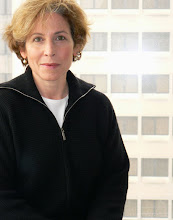
Some of you are concerned that asserting your opinion in the class, or participating in provocative discussion will harm your grade. Please be assured that this is not true. Although grading in a creatively based class does involve a level of subjectivity, I work very hard at the point of grading, to evaluate the work, the effort, and the comprehension of the course content. I do not view this class personally, I view it professionally. Although I genuinely like this class very much, that is a consideration that is secondary. The main point is that teaching has a purpose - which for me, is to stimulate growth - creatively and intellectually, and to introduce you to a way of thinking and working that will contribute to your life as you go forward. I do try to prod you in both gentle and more direct ways. It comes from an overall perspective that I work to balance. The balance is between how much of the stimulus comes from me, and how much comes from all of you towards each other.
As you know, I value attendance highly, as I think much of what happens in this class is based on process that evolves over time. I laid that out in the fist class and I think you have seen that develop over the course of the semester. But in the end, attendance and class participation are only 35% of the grade. Here for your review is the grading system from the syllabus:
Research, attendance and participation 35%
In class assignments 30%
Final project 35%
But the other criterion that I value and believe is part of the process of learning, is fun. In game design, the idea is called creative play. What I hope you will understand about this class, is that all of it - discussion, production, ideas - are integrated into an overall creative play - an environment where I hope profound learning is a by-product of experience.
The central kernal of the class is your own experience - how this process may reveal some inner aspects of yourself, and how that can be translated into a creative tool and become part of your language. The composition of that kernal is emotional, psychological and social - all aspects of human identity. The more you are able to take hold of this process and bring your own honesty and openness to it, the more you will get out of it. You have all done a wonderful job so far, it has been extremely interesting to be involved with you this semester. When we get together to critique the projects, and the class as a whole (as I appreciate your feedback as well), this understanding will be the lens of evaluation.
Sunday, November 23, 2008

Tuesday, November 18, 2008
Multiple Elements
Things that can be included in your projects. Using many elements and integrating them into an organic whole is the challenge.
Maps, charts, printed guides
Sound
Instructions
More than one location
The bus as location
Physical activity
Virtual activity
Physical + Virtual activity at the same time
Hand-crafted elements - sewing, drawing, rubbings
Digital Material - video, web sites, radio, GPS
Cell phones
Elimination of one sense (blind-folds, head-phones)
The archeologic debris of the area
Team activity
Cats
Maps, charts, printed guides
Sound
Instructions
More than one location
The bus as location
Physical activity
Virtual activity
Physical + Virtual activity at the same time
Hand-crafted elements - sewing, drawing, rubbings
Digital Material - video, web sites, radio, GPS
Cell phones
Elimination of one sense (blind-folds, head-phones)
The archeologic debris of the area
Team activity
Cats
Wodiczko
Krzyysztof Wodiczko, in his book Critical Vehicles, discusses his art work over the span of his career, all of it highly political in nature. What Wodiczko focuses on is designing for human interaction, and human relationship. What he higlights is the binary of power: victor/vanquished. This type of binary analysis of social space can easily be understood in relation to race and gender. What is interesting about his Prophet's Prothesis, is the idea of a doubling - the real person and the media double, both simultaneously walking through the city. Here we have the Derive or Drift retranslated through the integration of media. Inside/outside, real/virtual. These types of binaries fuse together so that the doubled experience creates a whole. Conceptually very interesting. One could even conceive of the doubled self - the real and virtual as a ying/yang.
On p. 13, his design summary could be considered a manifesto. He has articulated a social problem that he is trying to solve through design.
What we have said in this class, is that design solves problems. One must first identify the problem and then create the design to solve it.
On p. 13, his design summary could be considered a manifesto. He has articulated a social problem that he is trying to solve through design.
What we have said in this class, is that design solves problems. One must first identify the problem and then create the design to solve it.
Back to Heterotopias
We started our class with an essay called "Of Other Spaces" and the argument can be made that the mixed reality spaces that are created by the simultaneous experience of real place and the metaverse of Cyberspace is a third, heterotopic space - a time out of time, and a place out of place.
If you add some form of technology to your projects, you extend the space of the project; alter it, change the sequence of time and experience.
A brief summation by Rickie Sanders, Professor of Geography, Temple University:
In his paper, “Of Other Spaces” Michel Foucault called attention to the centrality of space in the 20th century. Indeed it has surpassed history as the great obsession of our time. In his paper he moves along a theoretical trajectory which builds on a medieval hierarchical notion of space, substitutes it with a modern theory of extended space, and ultimately displaces both with the postmodernist claim to site. The site, is both central to the culture and at the same time, set aside – the cemetery, the prison or the hospital – mirrored in the actions that take place there.
If you add some form of technology to your projects, you extend the space of the project; alter it, change the sequence of time and experience.
A brief summation by Rickie Sanders, Professor of Geography, Temple University:
In his paper, “Of Other Spaces” Michel Foucault called attention to the centrality of space in the 20th century. Indeed it has surpassed history as the great obsession of our time. In his paper he moves along a theoretical trajectory which builds on a medieval hierarchical notion of space, substitutes it with a modern theory of extended space, and ultimately displaces both with the postmodernist claim to site. The site, is both central to the culture and at the same time, set aside – the cemetery, the prison or the hospital – mirrored in the actions that take place there.
Understanding Space
All of you have picked a place for your final projects. The creative part of the assignment is to design a project/event/happening/performance/encounter in that place that activates the space. To do that, you have to bring together three things: some aspect of the history or dynamic of the place that you have researched, some aspect of your own experience and some experience of the interrelationship of the buildings, events and interactions that make up that space.
... and you need to read p. 28 in the Mapping Cyberspace reading on Theorising Space. Rob Kitchin lays out the history of how space has been thought about - Aristotelian - space is static, hierarchical and concrete; Newtonian - space is an absolute grid, within which objects are located and events occur; Leibnizian - space is fundamentally relational and defined in terms of those relationships; Kantian - space is conceptualized as a form imposed on the world by humans.
... and you need to read p. 28 in the Mapping Cyberspace reading on Theorising Space. Rob Kitchin lays out the history of how space has been thought about - Aristotelian - space is static, hierarchical and concrete; Newtonian - space is an absolute grid, within which objects are located and events occur; Leibnizian - space is fundamentally relational and defined in terms of those relationships; Kantian - space is conceptualized as a form imposed on the world by humans.
Manifestos
Some examples, far out and not:
Joseph Beuys, German conceptual artist: http://www.artnotart.com/fluxus/jbeuys-manifesto.html
Fluxus manifesto: http://www.artnotart.com/fluxus/index.html
White Manifesto by Lucio Fontana, "We are continuing the evolution of art."
The Italian Futurists wrote many manifestos. They wrote manifestos on everything from art to clothing. http://www.italianfuturism.org/manifestos/
This show in Chelsea (Oct. 23 - Dec. 20) has some beautiful work which translates Zapatista manifestos into musical scores (each letter of the alphabet which is also a note, becomes that note, and everything else is a pause/silence.) Kent Gallery, 541 West 25th Street http://www.kentgallery.com/index.html
The Dogme95 film-making manifesto that I mentioned in class http://www.dogme95.dk/the_vow/index.htm
You'll love this one: The Foundation and Manifesto of Futurism, Thomas Marinetti 1905 http://www.unknown.nu/futurism/manifesto.html
The Situationist Manifesto http://www.infopool.org.uk/6003.html
And this is the manifesto that will help you with the entire assignment and final project The Manifesto of Possibilities http://wiki.bbk.ac.uk/Buildingcultures/index.php/Manifesto_of_Possibilities
Joseph Beuys, German conceptual artist: http://www.artnotart.com/fluxus/jbeuys-manifesto.html
Fluxus manifesto: http://www.artnotart.com/fluxus/index.html
White Manifesto by Lucio Fontana, "We are continuing the evolution of art."
The Italian Futurists wrote many manifestos. They wrote manifestos on everything from art to clothing. http://www.italianfuturism.org/manifestos/
This show in Chelsea (Oct. 23 - Dec. 20) has some beautiful work which translates Zapatista manifestos into musical scores (each letter of the alphabet which is also a note, becomes that note, and everything else is a pause/silence.) Kent Gallery, 541 West 25th Street http://www.kentgallery.com/index.html
The Dogme95 film-making manifesto that I mentioned in class http://www.dogme95.dk/the_vow/index.htm
You'll love this one: The Foundation and Manifesto of Futurism, Thomas Marinetti 1905 http://www.unknown.nu/futurism/manifesto.html
The Situationist Manifesto http://www.infopool.org.uk/6003.html
And this is the manifesto that will help you with the entire assignment and final project The Manifesto of Possibilities http://wiki.bbk.ac.uk/Buildingcultures/index.php/Manifesto_of_Possibilities
Wednesday, November 12, 2008
Monday, November 10, 2008
Mapping Cyberspace
This is a very straightforward chapter. Lots of information. But the key point that Rob Kitchin brings up is how cyberspace refers to the conceptual space within the Information and communication technologies. That is key to our understanding of space and our definition of place.
p. 1 - At present, cyberspace does not consist of one homogenous space; it is a myriad of rapidly expanding cyberspaces, each providing a different form of digital interaction and communication.
Yes, so if we use any of them in our projects, how do we measure how they affect the space, place, experience or location of the project. In what way is this a microcosm of urban life as it is led on a daily basis.
This is a crucial chapter, it brings together many themes we have discussed in class. I will elaborate more at another time.
p. 1 - At present, cyberspace does not consist of one homogenous space; it is a myriad of rapidly expanding cyberspaces, each providing a different form of digital interaction and communication.
Yes, so if we use any of them in our projects, how do we measure how they affect the space, place, experience or location of the project. In what way is this a microcosm of urban life as it is led on a daily basis.
This is a crucial chapter, it brings together many themes we have discussed in class. I will elaborate more at another time.
Some other things
What I would say is most important is the sense of web 2.0 politics - open source, ground up authorship, networked, distributed. So, the integration of the social softwares such as blogger, twitter, Facebook or Ning, de.li.ci.ous, Flickr, Hipcast (or moblogging, podcasting etc.), Google Maps are core to the concepts of the class. If your projects can integrate with any of these applications, you get extra points. If you are doing something outside, but can include a web element, a map, a feature of some kind, extra points. If you can work on the idea of a MIXED REALITY experience - either a mixture of physical and networked experience, or mixed through sensory scrambling, or spatial re-organization etc.
The most effective projects have created experiences that start in one condition and end in another condition. Walking somewhere, putting something(s) somewhere and leaving them there, and that combine several of these concepts into one overall experience.
The idea of permanence vs. mutability, the ephemeral quality of technology as public art.
The idea that art and creativity can collapse multiple meanings into one experience.
Having the public or the class create the content for the project. You create the structure for gathering that content, asking for it, soliciting it, provoking it, creating it.
We will add to this list.
The most effective projects have created experiences that start in one condition and end in another condition. Walking somewhere, putting something(s) somewhere and leaving them there, and that combine several of these concepts into one overall experience.
The idea of permanence vs. mutability, the ephemeral quality of technology as public art.
The idea that art and creativity can collapse multiple meanings into one experience.
Having the public or the class create the content for the project. You create the structure for gathering that content, asking for it, soliciting it, provoking it, creating it.
We will add to this list.
Some issues
These are issues that we determined to underlie the NYU class. I think our class has other issues to add to this, and maybe some that were not as highly developed. Take a look at this list and think of what you would add or subtract:
Information Landscape is Everywhere
Geographic: by, at, in, on
Architectural: shape, volume
Social: history, interpersonal, regulatory (law, custom)
Presence: sensory, mental, time
Path: physical, communications
Some of the core elements that are addressed (sometimes critically and sometimes not) in Locative Media are control and surveillance (which are subtopics of regulation).
Information Landscape is Everywhere
Geographic: by, at, in, on
Architectural: shape, volume
Social: history, interpersonal, regulatory (law, custom)
Presence: sensory, mental, time
Path: physical, communications
Some of the core elements that are addressed (sometimes critically and sometimes not) in Locative Media are control and surveillance (which are subtopics of regulation).
Criteria of Evaluation
layers (how many)
thinking process
effort
growth in your own work
subjectivity (how well is expressed or understood in your method)
objectivity (what you have gathered from research)
extending or extention (any of the assignments or elements of your art practice)
issues of democracy (figure that out)
thinking process
effort
growth in your own work
subjectivity (how well is expressed or understood in your method)
objectivity (what you have gathered from research)
extending or extention (any of the assignments or elements of your art practice)
issues of democracy (figure that out)
Final Projects as of 11/10/08
RULES
We have 2 days for 3+ hours each day. Everyone MUST be on time for both presentation days. Everyone MUST attend both days + final review on date determined during exam week.
We will use cars on Wed. Dec. 3 and a bus will be provided by Rutgers for the final day of Wed. Dec. 10. The bus can also be a location, or integrated into your project if you so choose.
DRESS WARMLY - GLOVES, HATS, SCARVES, YOUR HEAVIEST COAT. It gets really cold on the street participating in these projects.
Locations so far:
275 George Street - C-Town Super
The cemetary
Train station
Corner of Senior Street and Eastern Ave. - Pete's Liquors
Corner of Front and Jersey
Bishop Street
College Ave. & Hamilton
The Hungarian Church - Livingston Ave.
Harvest Moon Brewery
We have 2 days for 3+ hours each day. Everyone MUST be on time for both presentation days. Everyone MUST attend both days + final review on date determined during exam week.
We will use cars on Wed. Dec. 3 and a bus will be provided by Rutgers for the final day of Wed. Dec. 10. The bus can also be a location, or integrated into your project if you so choose.
DRESS WARMLY - GLOVES, HATS, SCARVES, YOUR HEAVIEST COAT. It gets really cold on the street participating in these projects.
Locations so far:
275 George Street - C-Town Super
The cemetary
Train station
Corner of Senior Street and Eastern Ave. - Pete's Liquors
Corner of Front and Jersey
Bishop Street
College Ave. & Hamilton
The Hungarian Church - Livingston Ave.
Harvest Moon Brewery
Readings - a review list 11/10/08
Here is a list of all the readings so far:
Of Other Spaces (1967). Heterotopias, Michel Foucault.
The Garden of Forking Paths, Jorge Luis Borges
Space and Place, Yi Fu Tuan, chapters 1,2 & 6
A Different City for a Different Life, Constant (From the Internationale Situationiste 3 (December 1959)
Introducing Cyberspace from Mapping Cyberspace, Rob Kitchin and Martin Dodge 2002
Center-City, Empty Center; No Address; The Station, from Empire of Signs, Roland Barthes 1982
Voyage Around My Room, from the chapter Geography from The Atlas of Emotion, Journeys in Art, Architecture and Film, Guiliana Bruno, Verso 2002.
Critical Vehicles, Writings, Projects, Interviews by Krzysztof Wodiczko, MIT press 1999
Mapping the Homunculus by Steve Dietz from Else/Where: New Cartographies of Networks and Territories Ed. Janet Abrams and Peter Hall, University of MN Press, 2006.
Counter-Geographies by Brian Holmes from Else/Where: New Cartographies of Networks and Territories Ed. Janet Abrams and Peter Hall, University of MN Press, 2006.
Of Other Spaces (1967). Heterotopias, Michel Foucault.
The Garden of Forking Paths, Jorge Luis Borges
Space and Place, Yi Fu Tuan, chapters 1,2 & 6
A Different City for a Different Life, Constant (From the Internationale Situationiste 3 (December 1959)
Introducing Cyberspace from Mapping Cyberspace, Rob Kitchin and Martin Dodge 2002
Center-City, Empty Center; No Address; The Station, from Empire of Signs, Roland Barthes 1982
Voyage Around My Room, from the chapter Geography from The Atlas of Emotion, Journeys in Art, Architecture and Film, Guiliana Bruno, Verso 2002.
Critical Vehicles, Writings, Projects, Interviews by Krzysztof Wodiczko, MIT press 1999
Mapping the Homunculus by Steve Dietz from Else/Where: New Cartographies of Networks and Territories Ed. Janet Abrams and Peter Hall, University of MN Press, 2006.
Counter-Geographies by Brian Holmes from Else/Where: New Cartographies of Networks and Territories Ed. Janet Abrams and Peter Hall, University of MN Press, 2006.
Why We Care
Not only does semiotics affect how we understand symbol features of our urban landscape, it influences how we interpret both language and meaning and visual language and meaning. The construction of meaning in a photograph, for example, which we use liberally to document our work, and as part of the work itself. Beyond that, it has great value in the understanding of computer science, which is one of the internal engines of our project. The internet, our cell phones, our GPS technology all use computer science somewhere in their mechanism.
In computer science, where it is considered as an application of mathematical logic, semantics reflects the meaning of programs or functions.
In this regard, semantics permits programs to be separated into their syntactical part (grammatical structure) and their semantic part (meaning). For instance, the following statements use different syntaxes (languages), but result in the same semantic:
x += y; (C, Java, etc.)
x := x + y; (Pascal)
Let x = x + y; (early BASIC)
x = x + y (most BASIC dialects, Fortran)
Generally these operations would all perform an arithmetical addition of 'y' to 'x' and store the result in a variable called 'x'.
Semantics for computer applications falls into three categories:[12]
Operational semantics: The meaning of a construct is specified by the computation it induces when it is executed on a machine. In particular, it is of interest how the effect of a computation is produced.
Denotational semantics: Meanings are modelled by mathematical objects that represent the effect of executing the constructs. Thus only the effect is of interest, not how it is obtained.
Axiomatic semantics: Specific properties of the effect of executing the constructs as expressed as assertions. Thus there may be aspects of the executions that are ignored.
The Semantic Web refers to the extension of the World Wide Web through the embedding of additional semantic metadata; s.a. Web Ontology Language (OWL).
SO, MOST IMPORTANTLY< SEMANTICS CAN AFFECT HOW WE TAG OUR PROJECTS, HOW WE TAG OUR DATA, HOW WE CREATE A METADATA TO OUR PROJECTS THAT SIMULATES THE SEMANTIC WEB.
In computer science, where it is considered as an application of mathematical logic, semantics reflects the meaning of programs or functions.
In this regard, semantics permits programs to be separated into their syntactical part (grammatical structure) and their semantic part (meaning). For instance, the following statements use different syntaxes (languages), but result in the same semantic:
x += y; (C, Java, etc.)
x := x + y; (Pascal)
Let x = x + y; (early BASIC)
x = x + y (most BASIC dialects, Fortran)
Generally these operations would all perform an arithmetical addition of 'y' to 'x' and store the result in a variable called 'x'.
Semantics for computer applications falls into three categories:[12]
Operational semantics: The meaning of a construct is specified by the computation it induces when it is executed on a machine. In particular, it is of interest how the effect of a computation is produced.
Denotational semantics: Meanings are modelled by mathematical objects that represent the effect of executing the constructs. Thus only the effect is of interest, not how it is obtained.
Axiomatic semantics: Specific properties of the effect of executing the constructs as expressed as assertions. Thus there may be aspects of the executions that are ignored.
The Semantic Web refers to the extension of the World Wide Web through the embedding of additional semantic metadata; s.a. Web Ontology Language (OWL).
SO, MOST IMPORTANTLY< SEMANTICS CAN AFFECT HOW WE TAG OUR PROJECTS, HOW WE TAG OUR DATA, HOW WE CREATE A METADATA TO OUR PROJECTS THAT SIMULATES THE SEMANTIC WEB.
Semantics
The linguistic branch of semiotics. http://en.wikipedia.org/wiki/Semantics
A partial description here:
Semantics is the study of meaning in communication. The word derives from Greek σημαντικός (semantikous), "significant",[1] from σημαίνω (semaino), "to signify, to indicate" and that from σήμα (sema), "sign, mark, token".[2] In linguistics it is the study of interpretation of signs as used by agents or communities within particular circumstances and contexts.[3] It has related meanings in several other fields.
Semanticists differ on what constitutes meaning in an expression. For example, in the sentence, "John loves a bagel", the word bagel may refer to the object itself, which is its literal meaning or denotation, but it may also refer to many other figurative associations, such as how it meets John's hunger, etc., which may be its connotation. Traditionally, the formal semantic view restricts semantics to its literal meaning, and relegates all figurative associations to pragmatics, but this distinction is difficult to defend.[4] The degree to which a theorist subscribes to the literal-figurative distinction decreases as one moves from the formal semantic, semiotic, pragmatic, to the cognitive semantic traditions.
The word semantic in its modern sense is considered to have first appeared in French as sémantique in Michel Bréal's 1897 book, Essai de sémantique'. In International Scientific Vocabulary semantics is also called semasiology. The discipline of Semantics is distinct from Alfred Korzybski's General Semantics, which is a system for looking at non-immediate, or abstract meanings.
A partial description here:
Semantics is the study of meaning in communication. The word derives from Greek σημαντικός (semantikous), "significant",[1] from σημαίνω (semaino), "to signify, to indicate" and that from σήμα (sema), "sign, mark, token".[2] In linguistics it is the study of interpretation of signs as used by agents or communities within particular circumstances and contexts.[3] It has related meanings in several other fields.
Semanticists differ on what constitutes meaning in an expression. For example, in the sentence, "John loves a bagel", the word bagel may refer to the object itself, which is its literal meaning or denotation, but it may also refer to many other figurative associations, such as how it meets John's hunger, etc., which may be its connotation. Traditionally, the formal semantic view restricts semantics to its literal meaning, and relegates all figurative associations to pragmatics, but this distinction is difficult to defend.[4] The degree to which a theorist subscribes to the literal-figurative distinction decreases as one moves from the formal semantic, semiotic, pragmatic, to the cognitive semantic traditions.
The word semantic in its modern sense is considered to have first appeared in French as sémantique in Michel Bréal's 1897 book, Essai de sémantique'. In International Scientific Vocabulary semantics is also called semasiology. The discipline of Semantics is distinct from Alfred Korzybski's General Semantics, which is a system for looking at non-immediate, or abstract meanings.
Semiotics
The full description from Wikipedia http://en.wikipedia.org/wiki/Semiotics
A partial description here:
Semiotics, semiotic studies, or semiology is the study of sign processes (semiosis), or signification and communication, signs and symbols, both individually and grouped into sign systems. It includes the study of how meaning is constructed and understood. One of the attempts to formalize the field was most notably led by the Vienna Circle and presented in their International Encyclopedia of Unified Science, in which the authors agreed on breaking out the field, which they called "semiotic", into three branches:
Semantics: Relation between signs and the things they refer to, their denotata.
Syntactics: Relation of signs to each other in formal structures.
Pragmatics: Relation of signs to their impacts on those who use them. (Also known as General Semantics)
These branches are clearly inspired by Charles W. Morris, especially his Writings on the general theory of signs (The Hague, The Netherlands, Mouton, 1971, orig. 1938).
Semiotics is frequently seen as having important anthropological dimensions, for example Umberto Eco proposes that every cultural phenomenon can be studied as communication. However, some semioticians focus on the logical dimensions of the science. They examine areas belonging also to the natural sciences - such as how organisms make predictions about, and adapt to, their semiotic niche in the world (see semiosis). In general, semiotic theories take signs or sign systems as their object of study: the communication of information in living organisms is covered in biosemiotics or zoosemiosis.
A partial description here:
Semiotics, semiotic studies, or semiology is the study of sign processes (semiosis), or signification and communication, signs and symbols, both individually and grouped into sign systems. It includes the study of how meaning is constructed and understood. One of the attempts to formalize the field was most notably led by the Vienna Circle and presented in their International Encyclopedia of Unified Science, in which the authors agreed on breaking out the field, which they called "semiotic", into three branches:
Semantics: Relation between signs and the things they refer to, their denotata.
Syntactics: Relation of signs to each other in formal structures.
Pragmatics: Relation of signs to their impacts on those who use them. (Also known as General Semantics)
These branches are clearly inspired by Charles W. Morris, especially his Writings on the general theory of signs (The Hague, The Netherlands, Mouton, 1971, orig. 1938).
Semiotics is frequently seen as having important anthropological dimensions, for example Umberto Eco proposes that every cultural phenomenon can be studied as communication. However, some semioticians focus on the logical dimensions of the science. They examine areas belonging also to the natural sciences - such as how organisms make predictions about, and adapt to, their semiotic niche in the world (see semiosis). In general, semiotic theories take signs or sign systems as their object of study: the communication of information in living organisms is covered in biosemiotics or zoosemiosis.
Yi Fu Tuan Chapter 6
Spatial Ability, Knowledge and Place
KEY THEMES OF OUR CLASS!
P. 68 - Walking is a skill, but if I can "see" myself walking and if I hold that picture in mind sp that I can analyze how I move and what path I am following, then I also have knowledge. That knowledge is transferable to another person through EXPLICIT INSTRUCTION IN WORDS, WITH DIAGRAMS, AND IN GENERAL BY SHOWING HOW COMPLEX MOTION consists of parts that can be analyzed or imitated.
P. 73 - When space feels thoroughly familiar to us, it has become place. Kinesthetic and perceptual experience as well as the ability to form concepts are required for the change if the space is large.
How well do you relate to small or large spaces? Do you become disoriented in large spaces? How would you design an experience that relates small and large spaces so that the viewer/user has to orient through some kind of maze like experience to orient themselves.
What are the spaces that have become places for you? Like Rutgers campus itself?
KEY THEMES OF OUR CLASS!
P. 68 - Walking is a skill, but if I can "see" myself walking and if I hold that picture in mind sp that I can analyze how I move and what path I am following, then I also have knowledge. That knowledge is transferable to another person through EXPLICIT INSTRUCTION IN WORDS, WITH DIAGRAMS, AND IN GENERAL BY SHOWING HOW COMPLEX MOTION consists of parts that can be analyzed or imitated.
P. 73 - When space feels thoroughly familiar to us, it has become place. Kinesthetic and perceptual experience as well as the ability to form concepts are required for the change if the space is large.
How well do you relate to small or large spaces? Do you become disoriented in large spaces? How would you design an experience that relates small and large spaces so that the viewer/user has to orient through some kind of maze like experience to orient themselves.
What are the spaces that have become places for you? Like Rutgers campus itself?
Sunday, November 9, 2008
Saturday, November 8, 2008
Thursday, November 6, 2008
Wednesday, November 5, 2008
Tuesday, November 4, 2008
Monday, November 3, 2008
More Yi Fu Tuan notes
These are ideas that caught my attention:
tactile perception is at the extreme opposite of visual perception. The skin is able to convey certain spatial ideas and can do so without the support of other senses, depending on the structure of the body and the ability to move. (p. 14)
--- which leads me back to the push/pull exercise and the experience of touching your partner. How much information was communicated through touch? How do you spatially organize yourself in open and closed space?
Sounds, though vaguely located, can convey a strong sense of size (volume) and of distance. For example, in an empty cathedral the sound of footsteps tapping sharply on the stone floor creates an impression of cavernous vastness. (p15)
--- which makes me think of the creative possibilities of sound to create, record or alter space.
Three principal types of space (p. 17), with large areas of overlap, exist - the mythical, the pragmatic, and the abstract or theoretical. Mythical space is a conceptual schema, but it is also pragmatic space in the sense that within that schema a large number of practical activities, such as planting and harvesting of crops, are ordered. A difference between mythical and pragmatic space is that the latter is defined by a more limited set of economic activities.... When an ingenious person tries to describe the soil pattern cartographically, by means of symbols, a further move toward the conceptual mode occurs. In the Western world systems of geometry - that is highly abstract spaces - have been created out of primal experiences. Thus sensorimotor and tactile experiences would seem to lie at the root of Euclid's theorems concerning shape congruence and the parallelism of distant lines; and visual perception is the basis for projective geometry. (p.17)
---so how would you design an experience that would separate the senses, and give a single sense experience of space.
--- Where in New Brunswick, do you find mythical space and pragmatic space overlapping?
An object or place achieves concrete reality when our experience of it is total, that is, through all the senses as well as with the active and reflective mind. (p. 18)
---How can you deconstruct a place to recreate it as a new, whole, concrete experience?
tactile perception is at the extreme opposite of visual perception. The skin is able to convey certain spatial ideas and can do so without the support of other senses, depending on the structure of the body and the ability to move. (p. 14)
--- which leads me back to the push/pull exercise and the experience of touching your partner. How much information was communicated through touch? How do you spatially organize yourself in open and closed space?
Sounds, though vaguely located, can convey a strong sense of size (volume) and of distance. For example, in an empty cathedral the sound of footsteps tapping sharply on the stone floor creates an impression of cavernous vastness. (p15)
--- which makes me think of the creative possibilities of sound to create, record or alter space.
Three principal types of space (p. 17), with large areas of overlap, exist - the mythical, the pragmatic, and the abstract or theoretical. Mythical space is a conceptual schema, but it is also pragmatic space in the sense that within that schema a large number of practical activities, such as planting and harvesting of crops, are ordered. A difference between mythical and pragmatic space is that the latter is defined by a more limited set of economic activities.... When an ingenious person tries to describe the soil pattern cartographically, by means of symbols, a further move toward the conceptual mode occurs. In the Western world systems of geometry - that is highly abstract spaces - have been created out of primal experiences. Thus sensorimotor and tactile experiences would seem to lie at the root of Euclid's theorems concerning shape congruence and the parallelism of distant lines; and visual perception is the basis for projective geometry. (p.17)
---so how would you design an experience that would separate the senses, and give a single sense experience of space.
--- Where in New Brunswick, do you find mythical space and pragmatic space overlapping?
An object or place achieves concrete reality when our experience of it is total, that is, through all the senses as well as with the active and reflective mind. (p. 18)
---How can you deconstruct a place to recreate it as a new, whole, concrete experience?
Sunday, November 2, 2008
Yi Fu Tuan more reading notes
Yi Fu Tuan refers to the kind of properties that create a sense of place. He also questions, what is space, and how does one have a sense of spaciousness? In what ways do people attach meaning to space and place? The answer goes beyond the cultural; there are certain "animal" relationships to space and place... one could say, embodied senses of how we orient ourselves to space and place. We are interested in how space and place are understood, so that we can question how technology disorients our sense of space and place, or amplifies our sense of space and place.
Try to think of some ways you would answer this question.
Three themes run through Yi Fu Tuans book:
1) The biological facts
2) The relations of space and place
3) The range of experience or knowledge.
He amplifies these themes on page 6 of the Introduction. Please refer to that and fill out the meanings.
A key term in the book is "experience." What is the nature of experience and the experiential perspective? (Yi Fu Tuan, p.7)
Our class is also based on the development of experiential exercises. How has each one informed your sense of space or place?
Chapter 2 focuses on the Experiential Perspective. Experience is made up of sensation, perception and conception. These influence on a continuum, emotion and thought.
Experience is directed to the external world. Seeing and thinking clearly reach out beyond the self. Feeling however, reflects the way in which the self is inwardly affected. (p. 9).
This is important to think about because as you come to define your own experiences, it helps you think about how to design experiences for other people. The final project will be the result of a complex experience design.
Try to think of some ways you would answer this question.
Three themes run through Yi Fu Tuans book:
1) The biological facts
2) The relations of space and place
3) The range of experience or knowledge.
He amplifies these themes on page 6 of the Introduction. Please refer to that and fill out the meanings.
A key term in the book is "experience." What is the nature of experience and the experiential perspective? (Yi Fu Tuan, p.7)
Our class is also based on the development of experiential exercises. How has each one informed your sense of space or place?
Chapter 2 focuses on the Experiential Perspective. Experience is made up of sensation, perception and conception. These influence on a continuum, emotion and thought.
Experience is directed to the external world. Seeing and thinking clearly reach out beyond the self. Feeling however, reflects the way in which the self is inwardly affected. (p. 9).
This is important to think about because as you come to define your own experiences, it helps you think about how to design experiences for other people. The final project will be the result of a complex experience design.
Yi Fu Tuan reading notes
From the paper "Neighborhood Narratives, New Dialogues With/in the Mediated City", by Hana Iverson and Rickie Sanders. 2008.
Place, according to Yi Fu Tuan (1977) combines a sense of position within society and a sense of identity with a spatial location. Places have historically been viewed as physical sites, with natural and emotional endowments that speak to the limits of human freedom. Not only are our human identities bound up with the hills and valleys in which we live but our very humanness and humanity is bound in this way. It is place that gives rise to humanness – in the form of feelings, attachments, longing, nostalgia, desire, melancholy, and fear.
... Space is perhaps best thought of as a three dimensional void where things are held to exist only if they occupy volume. Location based technologies negate the consideration of volume and view space along the lines of abstract Cartesianism.
...Similarly, beginning with the 16th century, the conception of space which relied on the Cartesian coordinate system set in motion a marginalization of place. Space with its numerical properties was regarded as absolute and finite. Thus it was perceived as scientific and crucial to the goal of imperialism.
...Certain activities are accorded special spatial status, while others are not. Driving a truck is spatial (hence, work), talking on the phone is less spatial (hence, bureaucratic), and pondering an idea is simply ethereal (Sack, 1980, p. 17) hence, indolent.
Place, according to Yi Fu Tuan (1977) combines a sense of position within society and a sense of identity with a spatial location. Places have historically been viewed as physical sites, with natural and emotional endowments that speak to the limits of human freedom. Not only are our human identities bound up with the hills and valleys in which we live but our very humanness and humanity is bound in this way. It is place that gives rise to humanness – in the form of feelings, attachments, longing, nostalgia, desire, melancholy, and fear.
... Space is perhaps best thought of as a three dimensional void where things are held to exist only if they occupy volume. Location based technologies negate the consideration of volume and view space along the lines of abstract Cartesianism.
...Similarly, beginning with the 16th century, the conception of space which relied on the Cartesian coordinate system set in motion a marginalization of place. Space with its numerical properties was regarded as absolute and finite. Thus it was perceived as scientific and crucial to the goal of imperialism.
...Certain activities are accorded special spatial status, while others are not. Driving a truck is spatial (hence, work), talking on the phone is less spatial (hence, bureaucratic), and pondering an idea is simply ethereal (Sack, 1980, p. 17) hence, indolent.
Subscribe to:
Posts (Atom)